


Call Us
+86-573-83601567
Email Us
info@aoketrade.com

Aluminum Stamping: The Ultimate Beginner’s Guide
1. What Is Aluminum Stamping?
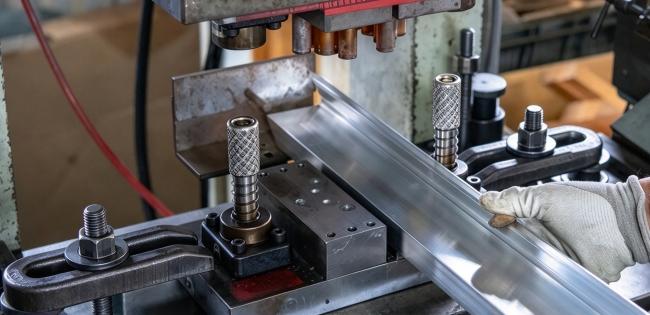
Aluminum stamping is a manufacturing process that uses a press and specialized dies to process flat aluminum sheets or coils into finished parts. As a form of sheet metal stamping, this process includes operations such as cutting, bending, and stretching to achieve the desired shape.
Aluminum stamping is usually performed at room temperature and is classified as a cold forming process. It is widely used for mass production of lightweight, corrosion-resistant components. Compared to steel, aluminum requires meticulously designed dies to control springback and prevent cracking, but it has significant advantages in reducing weight and recyclability.
2. Why Choose Aluminum for Stamping?
Choosing aluminum for stamping processing has the following major advantages:
- Lightweight: The weight of aluminum is about one-third that of steel, which can significantly reduce the overall weight of the product.
- Corrosion Resistant: Its natural oxide layer provides protection without the need for additional coatings.
- Conductive: High conductivity and thermal performance make it suitable for electronic and thermal management components.
- Recyclable: Aluminum resources are highly sustainable and easy to recycle.
- Non-magnetic: Very suitable for electromagnetic interference shielding and applications sensitive to electronic components.
These characteristics make aluminum stamped parts an ideal choice in industries that prioritize weight reduction, durability, and cost-effectiveness.
3. Common Aluminum Stamping Processes
Blanking and Piercing
Blanking is the process of cutting a flat profile from an aluminum sheet to form the blank needed for subsequent forming. Piercing, on the other hand, creates holes or slots in the material. These processes are usually the first step in the aluminum stamping process and can be performed separately or completed in a continuous die.
Bending and Forming
Bending can create angles and simple cross-sectional shapes on a straight axis, such as brackets and clamps. Forming can produce more complex three-dimensional shapes. Since the elastic modulus of aluminum is lower than that of steel, the springback phenomenon is more pronounced, so the mold design must consider compensation angles or perform pre-bending.
Deep Drawing
Deep drawing transforms a flat aluminum blank into a hollow, cup-shaped part by radially drawing the material into a die cavity. Aluminum alloys with high ductility, such as 3003 and 5052, are preferred for deep drawing. Proper lubrication and controlled blank holder force are critical to prevent wrinkling and tearing. Typical applications include battery housings, cans, and enclosures.
Progressive Die Stamping
Progressive die stamping continuously feeds the aluminum strip into forming through multiple stations within a single die. Each station performs different operations, such as perforating, bending, and forming, until the part is completed and separated from the feed belt. This method is suitable for mass production of medium to small-sized parts, with advantages of high speed, high repeatability, and low unit cost.
Transfer Die Stamping
Transfer die stamping is used for large aluminum parts that cannot be efficiently produced through progressive dies. The parts are mechanically transferred from one die station to the next, with each station performing independent machining operations. This process offers greater flexibility for complex geometries and is often used in the manufacturing of automotive structural components and large housings.
4. Limitations of Aluminum Stamping
- Springback – Aluminum has a lower elastic modulus than steel, so it tends to spring back after forming. Dies must be designed with compensation angles or over-bending to achieve accurate final dimensions.
- Galling and Adhesion – Aluminum is relatively soft and can stick to tool surfaces, causing scratches or buildup. Polished dies, specialized coatings, and proper lubrication are often required.
- Higher Material Cost – Although aluminum is lighter, the cost per kilogram is typically higher than carbon steel, which can increase raw material expenses for low-volume runs.
- Lower Strength Ceiling – Even high-strength aluminum alloys have lower ultimate tensile strength than many high-strength steels, making them unsuitable for extremely heavy-load structural parts.
- Deep Drawing Challenges – Aluminum is more prone to wrinkling and tearing during deep drawing than steel, demanding precise control of blank holder force and lubrication.
5. Conclusion
Aluminum stamping can provide lightweight, corrosion-resistant components for large-scale production at competitive costs. To achieve success, you need the right alloys, molds, and process controls.
At Aoke, we offer a full range of aluminum metal stamping services, from design support to mass production. Contact us now to discuss your next project.
Send Inquiry



X
We use cookies to offer you a better browsing experience, analyze site traffic and personalize content. By using this site, you agree to our use of cookies.
Privacy Policy
News
 Metal Riveting:A Beginner’s Guide for Sheet Metal Stamping Projects2026/11/06
Metal riveting is a classic permanent mechanical joining method for sheet metal stamping. This article explains riveting workflow, compares application scenarios for solid rivets, blind rivets and semi tubular rivets, sorts out pros and cons, and distinguishes riveting from welding with real world c......
 Shearing in Sheet Metal Fabrication & Stamping: Parameters, Equipment & Quality Guide2026/11/04
Shearing is an essential cold-working pre-process for sheet metal fabrication and metal stamping. Although sharing the same cutting principle, shearing for custom fabrication and high-volume stamping differs greatly in goals, machines and quality standards. This article compares guillotine shearing,......