


Call Us
+86-573-83601567
Email Us
info@aoketrade.com

Why are threadlocking adhesives categorized into chemical adhesives and nylon adhesives?
The distinction between chemical and nylon threadlocking adhesives stems from their fundamental differences in anti-loosening principles, curing mechanisms, disassembly properties, and applicable scenarios. These variations enable them to meet distinct requirements for anti-loosening strength, sealing performance, maintainability, and cost efficiency across different operating conditions. Therefore, clear differentiation is essential in practical production and application.
Nylon adhesive primarily achieves anti-loosening through physical filling and frictional resistance. By spraying nylon material onto thread surfaces to form an elastic buffer layer, it fills thread gaps and generates sustained compressive force during screw tightening. It features no curing requirement, allows repeated disassembly, offers easy assembly, and has relatively low cost. This makes it more suitable for applications requiring frequent maintenance or prioritizing disassembly convenience.
Chemical adhesives, however, rely on chemical reactions to form a bonded structure. During screw tightening, the adhesive undergoes a curing reaction, tightly bonding the internal and external threads together. This achieves high-strength anti-loosening along with excellent sealing, leak prevention, and corrosion resistance. However, it is typically non-reusable and is more suitable for critical areas subject to strong vibration, high pressure, stringent sealing requirements, and infrequent maintenance.
Precisely because nylon adhesives and chemical adhesives cannot substitute each other in performance and cater to distinct application needs, they must be clearly differentiated within the thread-coating product system. This ensures compliance with specialized anti-loosening requirements for screws across various industries and equipment.
Send Inquiry



X
We use cookies to offer you a better browsing experience, analyze site traffic and personalize content. By using this site, you agree to our use of cookies.
Privacy Policy
News
 Guide to Selecting Fastener Materials: Material Determines Performance, Heat Treatment Determines Strength, and Surface Treatment Determines Service Life!2026/07/13
A single sentence that captures the essence of the fastener industry: Choose the wrong material, and even the strongest fastener will break; Choose the wrong heat treatment, and even the highest-rated fastener is merely a false claim; Choose the wrong surface treatment, and even the best screw wi......
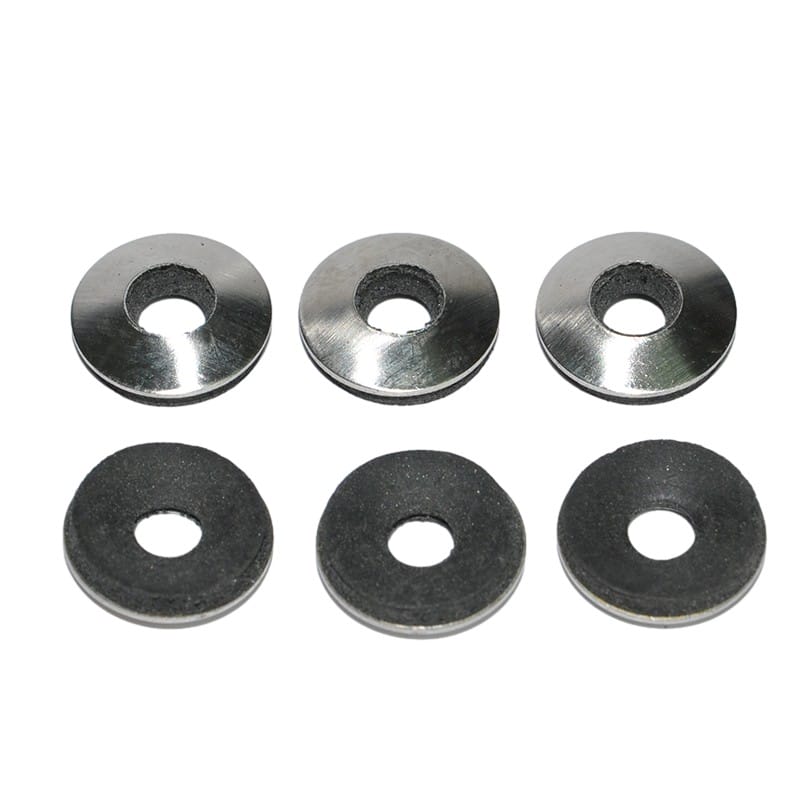 Jiaxing Aoke – Reliable Supplier of High-Performance EPDM Bonded Washers2026/07/10
Featuring prominent advantages such as aging resistance, high and low temperature resistance, water and vapor resistance, high resilience and ultra-long service life, EPDM bonded washers have become the most widely used and cost-effective sealing consumables for engineering supporting applications. ......