


Call Us
+86-573-83601567
Email Us
info@aoketrade.com

Can wedge thread nuts resist loosening under continuous vibration & high-low temperature cycles?
As stamped elastic components, non-metallic damping pads are widely adopted in automotive body noise reduction structures to optimize Automotive NVH performance. Improper control of hole position and dimensional tolerance of stamped parts will cause axial interference with body welded studs during assembly. The squeezed damping pad forms an unexpected interlayer and triggers soft connection failure. Many stamped parts pass torque inspection in small batch trial assembly, yet after mass production, bolt preload continuously decays due to material creep, vibration and temperature cycling, leading to front cowl abnormal noise and wind leakage.
1.Case & Test Data
We carried out multiple groups of comparative bench durability tests for a front cowl damping pad assembly project under axial damping pad interference condition to quantify the preload retention capacity of different nuts:
- Test condition: 1000h combined high-low temperature cycling & vibration durability test, simulating long-term vehicle service, monitoring torque and residual preload changes synchronously;
- Ordinary nut group: After test, the maximum bolt preload attenuation reached 42%. Micro-slip appeared on joints, and disassembly inspection showed irreversible creep compression of damping pads, residual clamping load of thread pairs below the design lower limit;
- Nylon lock nut group: Under identical test conditions, nylon ring aged under high temperature, maximum preload attenuation reached 35%, anti-loosening performance decreased sharply under high temperature;
- Aoke Anti-loosening Nut group: Under identical test conditions, residual preload retention rate stably maintained ≥88%, no thread rotation and loosening. It effectively offsets preload loss caused by damping pad creep;
- Real vehicle road test: Vehicles equipped with Aoke anti-loosening nuts showed no thread rotation after disassembly, no abnormal noise or wind leakage after 12000km road test.
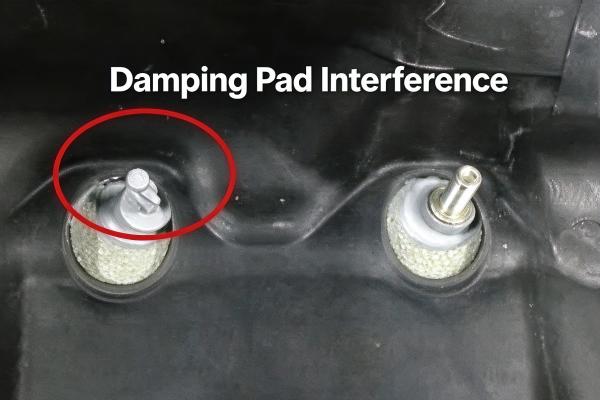
Comparative tests prove that ordinary nuts, spring washers and nylon lock nuts cannot cope with creep failure of soft connections with non-metallic interlayers. With wedge thread structure, Aoke anti-loosening nuts do not rely on contact friction and are suitable for interlayer conditions with creep-prone damping pads.
2. Analysis of Failure Mechanism
- Stress Relaxation After compression, molecular chains of polymer damping pad slide and rearrange, elastic stress releases continuously, and bolt clamping force slowly decreases over time.
- Creep Deformation Under long-term bolt preload load, damping pads undergo continuous plastic compression and thinning, elastic elongation of thread pairs reduces and preload drops. It is the core focus of creep failure prevention.
- Dynamic loads amplify failure Driving vibration and temperature alternation bring alternating loads, causing micro-slip of thread pairs and accelerating fatigue damage of damping pads. The difference in thermal expansion coefficient between metal and non-metallic materials creates additional thermal stress, and preload decreases non-linearly and rapidly.
Dimensional deviation of stamped parts is the root trigger. Offset hole position and excessive contour tolerance lead to alignment error during assembly, and the damping pad is squeezed by stud head to form interlayer. Traditional spring washers and ordinary nuts rely on friction anti-loosening. Once the interlayer creeps and becomes thinner, friction locking fails rapidly.
3. Technical Advantages of Aoke Anti-loosening Nut
- 30° wedge thread mechanical locking
- All-metal structure, excellent vibration & temperature resistance
- Reusable and compatible with standard bolts
- Wide application in automotive soft interlayer joints
4. Integrated Risk Prevention Solution for Stamped Parts & Fasteners
With cooperating stamping factory Jiaxing Aoke Hardware and our fastener technical capability, we realize collaborative evaluation of stamping structure and fasteners, and reduce soft connection failure probability from the source:
✅ DFMEA review at early stage of stamped parts: Evaluate hole position and contour tolerance, optimize stamping structure and avoid damping pad assembly interference;
✅ Collaborative fastener selection: Predict creep characteristics of damping pads and recommend supporting solutions including Aoke anti-loosening nuts;
✅ Sample reliability verification: Bench tests for creep, transverse vibration and preload decay, complete verification before mold finalization and cut rectification cost in mass production;
✅ Integrated supply: Combined delivery of stamped sheet metal for damping pads and fasteners, unified dimensional tolerance control to improve assembly matching;
✅ Mass production risk prediction: Continuously monitor dimensional fluctuation of stamped parts, identify batch assembly risks in advance and guarantee stable delivery, and provide on-site assembly technical guidance synchronously.
Damping pad interference caused by tolerance deviation of stamped parts will directly induce soft connection creep failure. Such problems cannot be solved only by optimizing stamped parts or replacing ordinary fasteners. Collaborative design of stamping structure and fastener anti-loosening scheme is required. With wedge thread mechanical locking, Aoke anti-loosening nuts effectively resist preload attenuation caused by non-metallic interlayer creep. We provide integrated supply chain service of stamped parts and fasteners, covering structural design, material evaluation and reliability verification to avoid soft connection failure risks in advance.
Send Inquiry



X
We use cookies to offer you a better browsing experience, analyze site traffic and personalize content. By using this site, you agree to our use of cookies.
Privacy Policy
News
 Guide to Selecting Fastener Materials: Material Determines Performance, Heat Treatment Determines Strength, and Surface Treatment Determines Service Life!2026/07/13
A single sentence that captures the essence of the fastener industry: Choose the wrong material, and even the strongest fastener will break; Choose the wrong heat treatment, and even the highest-rated fastener is merely a false claim; Choose the wrong surface treatment, and even the best screw wi......
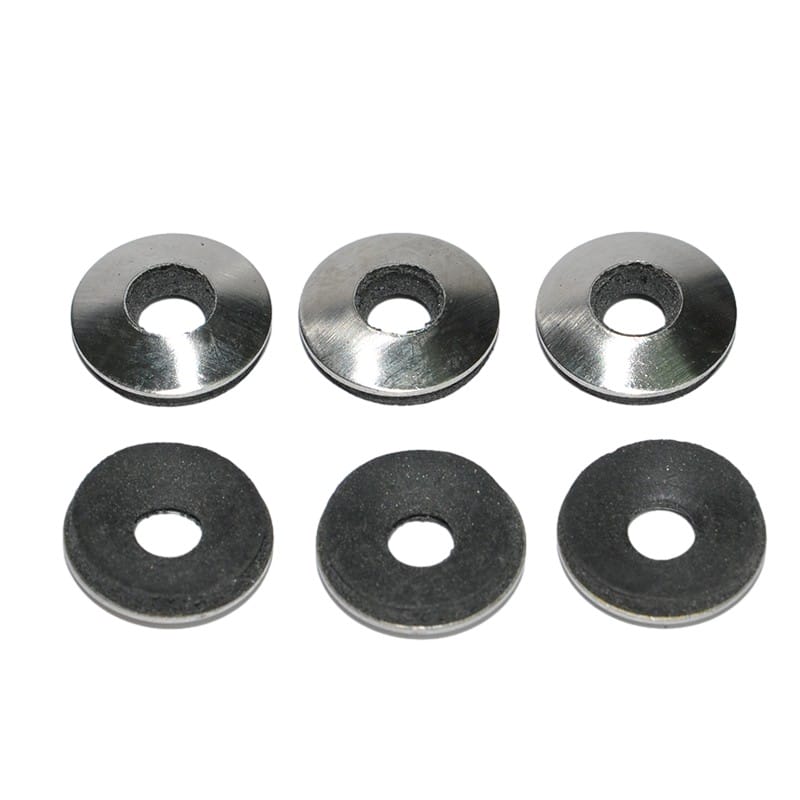 Jiaxing Aoke – Reliable Supplier of High-Performance EPDM Bonded Washers2026/07/10
Featuring prominent advantages such as aging resistance, high and low temperature resistance, water and vapor resistance, high resilience and ultra-long service life, EPDM bonded washers have become the most widely used and cost-effective sealing consumables for engineering supporting applications. ......