


Call Us
+86-573-83601567
Email Us
info@aoketrade.com

What is the difference between hot-dip galvanized bolts and Dacromet bolts?
Dacromet, known in China as a zinc-chromium coating, is a new type of anti-corrosion coating primarily composed of zinc powder, aluminum powder, chromic acid, and deionized water.
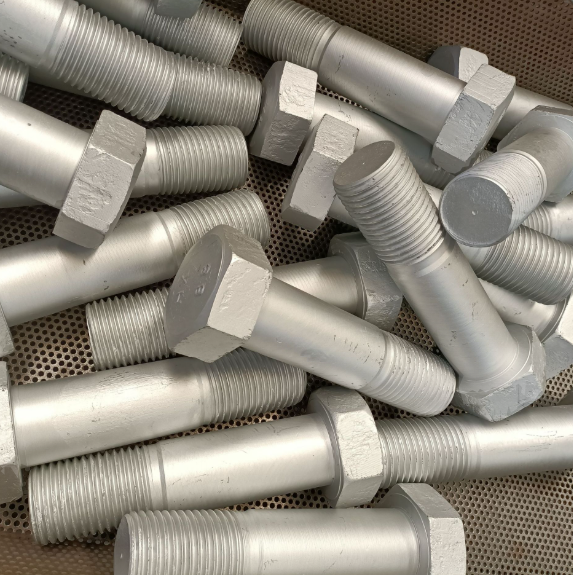
Dacromet bolts
Hot-dip galvanizing involves immersing rust-removed steel components into molten zinc at approximately 500°C, causing a zinc layer to adhere to the surface of the steel components, thereby providing corrosion protection.
Hot-dip galvanizing process: Finished product acid washing – water rinsing – application of flux – drying – galvanizing – cooling – chemical treatment – cleaning – polishing – completion of hot-dip galvanizing. Hot-dip galvanizing evolved from older hot-dip methods. Since France first applied hot-dip galvanizing to industrial applications in 1836, the process has a history of over 170 years.
Hot-dip galvanized bolts
Hot-dip galvanized bolts and Dacromet bolts have distinct differences, such as in materials, manufacturing methods, and operating environments. After undergoing specialized processing, these two types of bolts exhibit significant differences in corrosion resistance, which is the most notable distinction between them.
Materials:
Hot-dip galvanized bolts are made from zinc-coated steel and zinc alloys. They are coated with zinc using an electrolytic coating process that typically involves a protective layer, enabling them to withstand various forms of corrosion and ensuring a long service life.
Dacromet bolts are made from zinc-free steel and utilize an atmospheric hot-dip coating process, replacing traditional cold-dip coating. Electrophoresis allows for a higher concentration of zinc in the coating, resulting in a higher zinc content per unit mass, which effectively resists corrosion from gases in the marine atmosphere.
Manufacturing Process:
Hot-dip galvanized bolts require various surface treatments, such as spraying or controlled-temperature evaporation, to roughen the surface, giving them a distinct advantage in corrosion protection.
Dacromet bolts first undergo dimensional modification of the zinc-free steel, followed by atmospheric hot-dip coating, resulting in a smoother surface. Consequently, their corrosion resistance is inferior to that of hot-dip galvanized bolts.
Operating Environments:
Hot-dip galvanized bolts possess exceptional resistance to acids, alkalis, and corrosion, enabling them to operate in complex environments such as those with high humidity, high temperatures, or air pollution.
Dacromet bolts are suitable only for limited environments, such as those with normal temperatures, low humidity, or negligible air pollution.
Send Inquiry



X
We use cookies to offer you a better browsing experience, analyze site traffic and personalize content. By using this site, you agree to our use of cookies.
Privacy Policy
News
 Guide to Selecting Fastener Materials: Material Determines Performance, Heat Treatment Determines Strength, and Surface Treatment Determines Service Life!2026/07/13
A single sentence that captures the essence of the fastener industry: Choose the wrong material, and even the strongest fastener will break; Choose the wrong heat treatment, and even the highest-rated fastener is merely a false claim; Choose the wrong surface treatment, and even the best screw wi......
 Jiaxing Aoke – Reliable Supplier of High-Performance EPDM Bonded Washers2026/07/10
Featuring prominent advantages such as aging resistance, high and low temperature resistance, water and vapor resistance, high resilience and ultra-long service life, EPDM bonded washers have become the most widely used and cost-effective sealing consumables for engineering supporting applications. ......