


Call Us
+86-573-83601567
Email Us
info@aoketrade.com

Why Grade 12.9 Bolts Are Prone to Unexpected Fracture? Fastener Selection Tips for Stamping Assembly
During the assembly design of automotive components, industrial equipment housings and pressure vessel sheet metal stamping assemblies, many customers tend to select Class 12.9 high-strength bolts for threaded connections of stamped parts. They subjectively believe that higher tensile strength can improve the load capacity of the whole sheet metal stamping assembly. However, feedback from numerous project sites shows that blind use of Class 12.9 bolts is more likely to trigger sudden fracture. At the moment of bolt fracture, the released concentrated stress will tear the mounting holes of stamped parts and deform sheet metal brackets, scrapping the entire stamped structural assembly and greatly increasing the cost of subsequent equipment overhaul.
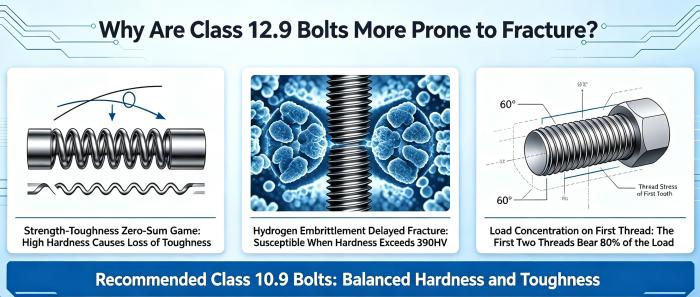
Trade-off Between Strength and Toughness: Brittle Fracture Risk under Alternating Loads
Improved strength comes at the cost of reduced toughness. After heat treatment, Grade 12.9 bolts reach 385 435HV in hardness, accompanied by obvious drops in elongation and impact toughness. Stamped parts endure continuous alternating loads during equipment operation, and sheet metal will produce tiny deformations. Bolts need plastic deformation to absorb vibration stress. Grade 12.9 material lacks sufficient plastic buffer. Stress concentrates at thread roots and causes unannounced brittle fracture under continuous vibration. For most dynamic stamping assembly scenarios, Grade 10.9 bolts strike a good balance between strength and toughness, fit the elastic deformation characteristics of stamping sheets and deliver better connection stability.
Unique Hidden Hazard for Stamping Applications: Hydrogen Embrittlement Risk
To meet anti-corrosion requirements for stamped parts, mating bolts are usually electroplated. High-strength Grade 12.9 steel is highly sensitive to hydrogen embrittlement. Hydrogen atoms penetrating during electroplating slowly accumulate under preload stress and lead to delayed fracture. If the bolt breaks, the whole stamping assembly loosens, resulting in high rework and shutdown costs.
Fastener Selection Recommendations for Stamping Assembly
1. Do not blindly choose Grade 12.9 for sheet metal stamping and dynamic vibration assembly; evaluate Grade 10.9 bolts first.
2. If Grade 12.9 bolts are mandatory, de-hydrogen baking must be added in surface treatment to strictly control hydrogen embrittlement.
3. Provide stamping sheet thickness, load and vibration parameters in the design phase for matched fastener dimensions and performance grades.
4. One-stop procurement of stamping parts plus supporting high-strength fasteners for unified quality control of the whole connection system.
Jiaxing Aoke Trading offers custom stamping part processing together with standard & non-standard fasteners. We design connection solutions for stamping assembly projects in one stop, preventing fracture failures caused by improper fastener selection and ensuring long-term stable operation of stamped assemblies.
Send Inquiry



X
We use cookies to offer you a better browsing experience, analyze site traffic and personalize content. By using this site, you agree to our use of cookies.
Privacy Policy
News
 Guide to Selecting Fastener Materials: Material Determines Performance, Heat Treatment Determines Strength, and Surface Treatment Determines Service Life!2026/07/13
A single sentence that captures the essence of the fastener industry: Choose the wrong material, and even the strongest fastener will break; Choose the wrong heat treatment, and even the highest-rated fastener is merely a false claim; Choose the wrong surface treatment, and even the best screw wi......
 Jiaxing Aoke – Reliable Supplier of High-Performance EPDM Bonded Washers2026/07/10
Featuring prominent advantages such as aging resistance, high and low temperature resistance, water and vapor resistance, high resilience and ultra-long service life, EPDM bonded washers have become the most widely used and cost-effective sealing consumables for engineering supporting applications. ......