


Call Us
+86-573-83601567
Email Us
info@aoketrade.com

Lock‑nut Selection for Stamped‑Welded Assemblies: All‑Metal Self‑Locking Nut vs Nylon Insert Lock Nut
Frames, brackets and enclosures of various kinds of equipment extensively adopt precision stamped‑assembly structures. Even if stamping parts achieve satisfactory machining accuracy, improperly matched lock nuts will lead to premature failure of connection joints under vibration, high‑temperature and salt‑spray conditions, which greatly undermines the reliability of the whole stamped assembly system. From the perspective of stamping‑assembly applications, this paper compares all‑metal self‑locking nuts and nylon insert lock nuts and provides selection references for stamped‑assembly projects.
Stamped‑welded assemblies are widely applied in environmental‑protection equipment, rail transit, port machinery and new‑energy facilities. After stamping forming, welding and high‑temperature treatment, the reliability of assembly joints directly determines the service life of the whole assembly. Many projects pay close attention to the machining precision of stamping parts themselves, yet overlook the working‑condition adaptability of matching anti‑loosening fasteners. Stamped components are often subjected to welding high temperature, outdoor salt‑spray corrosion and continuous equipment vibration. Mis‑selected lock nuts will suffer anti‑loosening failure, resulting in displacement of stamped brackets, enlarged assembly gaps and eventual breakdown of the complete assembly.
1. Working Principles of Two Anti‑Loosening Nuts
1.1 Nylon Insert Lock Nut
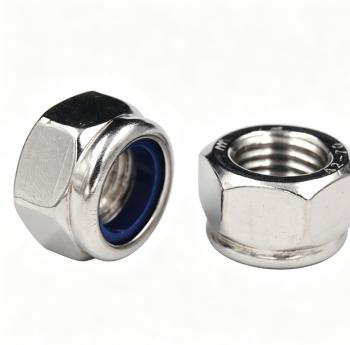
A nylon ring is pressed inside the nut. Anti‑loosening is realized by friction generated when bolts are screwed in and squeeze the nylon insert. It is mostly produced by cold heading instead of stamping. Restricted by the physical properties of nylon polymer, it has obvious weaknesses in temperature resistance and aging resistance.
1.2 All‑Metal Self‑Locking Nut
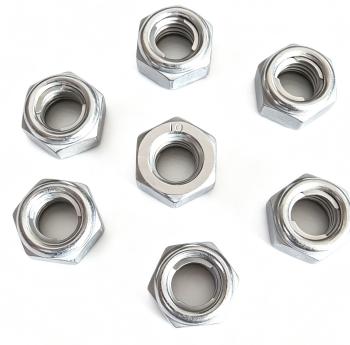
It is made entirely of metal without plastic components. It falls into two categories: cold‑heading self‑locking nuts and stamped self‑locking nuts. The stamped version forms locking features through sheet‑metal stamping, bending and closing‑in. Suitable for thin‑plate assemblies and special mounting positions, it is a widely‑used special stamped fastener for sheet‑metal equipment. Mechanical anti‑loosening is achieved via metal deformation that clamps the threads.
Stamping Working Condition Adaptation
Nylon Insert Lock Nut
All-Metal Self-Locking Nut
Welded Stamping Assembly Compatibility
❌ Completely incompatible. Welding high temperature melts the nylon locking ring and causes locking failure
✅ Perfectly compatible. The metal structure resists welding residual heat and local high temperature
Outdoor / Coastal Salt Spray Condition
❌ Nylon is prone to aging, cracking and pulverization, leading to loosening failure in a short time
✅ Stainless steel material resists salt spray and corrosion for long-term outdoor service
Vibration-Resistant Stamping Frame & Bracket
⭕ Only applicable to static, light-load and non-stressed housings
✅ Preferred for high-frequency vibration, dynamic load and load-bearing structures
Repeated Disassembly for Equipment Maintenance
❌ Anti-loosening performance drops sharply after more than 2 disassemblies, non-reusable
✅ Supports repeated maintenance disassembly with stable torque and no failure
Dimensional Stability of Stamping Assemblies
Prone to loosening during long-term use, causing assembly deviation and displacement
Constant locking force ensures long-term assembly precision of stamping assemblies
Adaptability to High-End Export Projects
Low adaptability, difficult to pass overseas engineering material audits
High adaptability with complete compliant documents, meeting strict overseas project standards
2. Selection Guidance for Stamping Industry
2.1 Stamping scenarios where nylon insert lock nuts are prohibited
All stamped assemblies with welding procedures, stamped components for wind‑power and new‑energy structures, outdoor coastal equipment brackets, load‑bearing stamping frames, sheet‑metal parts for dynamically vibrating equipment, and export‑oriented stamping projects requiring regular maintenance. Applying nylon nuts under these conditions will easily result in batch failures, project rework and customer complaints.
2.2 Stamping scenarios suitable for nylon insert lock nuts
Indoor‑only application, no welding process, normal‑temperature static environment, light‑load non‑stress housings, no subsequent disassembly requirements, and stamping accessories for ordinary civil equipment. When no harsh working conditions are involved, procurement costs can be reasonably controlled.
2.3 Optimal solution for high‑end stamping projects
For high‑requirement stamping projects such as overseas exports, offshore engineering, wind‑power equipment and heavy‑duty complete sets of machinery, stainless‑steel all‑metal self‑locking nuts are strongly recommended. They eliminate loosening risks at the fastener end, guarantee structural strength, assembly precision and operational stability of complete stamped assemblies, and satisfy strict overseas standards for material audit, traceability and delivery.
3. Procurement Summary for Stamping Supply Chain
The machining accuracy of stamping parts lays the foundation for equipment quality, while the anti‑loosening performance of matching fasteners determines long‑term service life. Many enterprises only focus on the unit price of stamping parts but ignore fastener working‑condition matching. This leads to the combination of “high‑precision stamping parts plus poorly‑matched fasteners”, which degrades the overall product quality. Amid current nickel raw‑material volatility and increasingly stringent overseas procurement audits, material compliance, performance matching and stable delivery constitute the core competitiveness of high‑end stamping supply chains.
Send Inquiry



X
We use cookies to offer you a better browsing experience, analyze site traffic and personalize content. By using this site, you agree to our use of cookies.
Privacy Policy
News
 Guide to Selecting Fastener Materials: Material Determines Performance, Heat Treatment Determines Strength, and Surface Treatment Determines Service Life!2026/07/13
A single sentence that captures the essence of the fastener industry: Choose the wrong material, and even the strongest fastener will break; Choose the wrong heat treatment, and even the highest-rated fastener is merely a false claim; Choose the wrong surface treatment, and even the best screw wi......
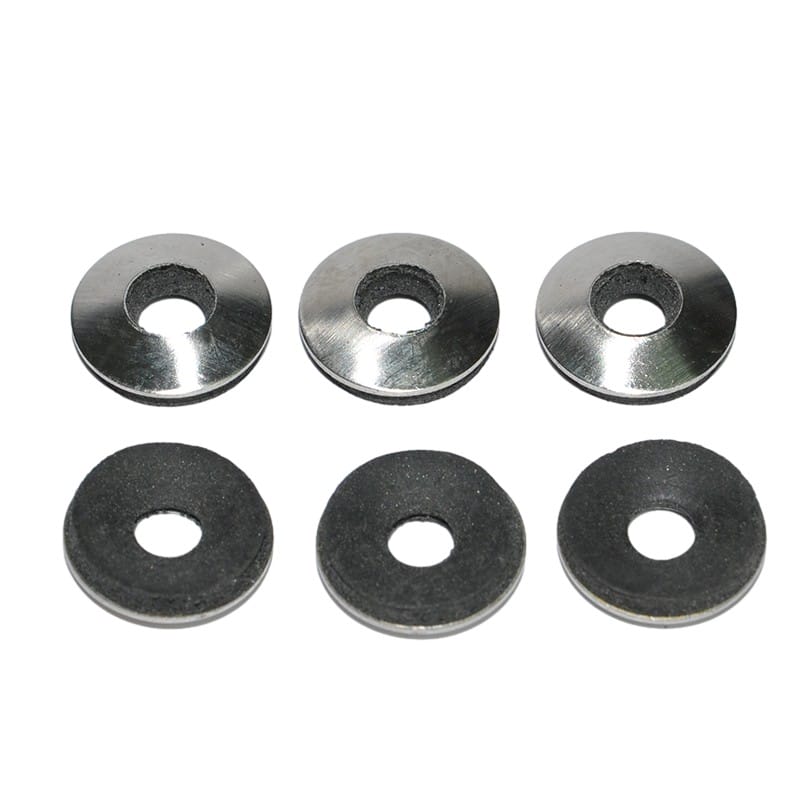 Jiaxing Aoke – Reliable Supplier of High-Performance EPDM Bonded Washers2026/07/10
Featuring prominent advantages such as aging resistance, high and low temperature resistance, water and vapor resistance, high resilience and ultra-long service life, EPDM bonded washers have become the most widely used and cost-effective sealing consumables for engineering supporting applications. ......