


Call Us
+86-573-83601567
Email Us
info@aoketrade.com

Low-Carbon 316L Flex Lock Nut: Matching High-Demanding Stamping-Assembly Systems Against Corrosion & Vibration
Equipment frames, load‑bearing brackets and equipment enclosures are mostly constructed with high‑precision stamped components. Featuring high dimensional accuracy, structural uniformity and stable batch consistency, stamped parts are widely adopted in complete sets of heavy industry, environmental protection, chemical and rail transit equipment. In actual manufacturing, most large stamping assemblies undergo integral welding, high‑temperature shaping and weld polishing thermal processes.
When ordinary stainless steel fasteners are matched with welded stamping structures, welding heat easily causes material sensitization. High temperature accelerates the precipitation of chromium carbide at grain boundaries, resulting in chromium depletion and forming invisible weak corrosion zones at thread contact surfaces and assembly joints. Under the combined effects of coastal salt spray, chemical acid‑base media, humid outdoor atmosphere and high‑frequency mechanical vibration, fastening points gradually suffer micro‑corrosion, gap loosening and fatigue cracking. Even if the stamping body maintains high precision and no deformation, the entire stamping assembly system will face connection failure, equipment jitter and precision deviation, greatly shortening the overall service life.
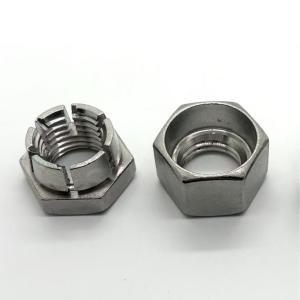
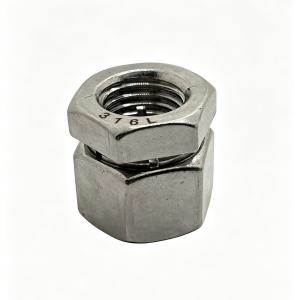
To fully address sensitization failure and intergranular corrosion triggered by welding heat, salt spray and humid harsh environments, Jiaxing Aoke Trading Co., Ltd., together with its supporting manufacturer Jiaxing Aoke Hardware, presents the heavy‑duty premium M20 316L Flex Lock Nut. Marked by the letter “L” for low‑carbon grade, its carbon content is strictly limited to ≤0.03%. Compared with standard 316 stainless steel, the ultra‑low‑carbon composition fundamentally inhibits chromium carbide precipitation at grain boundaries during welding and thermal processing and prevents material sensitization and post‑weld corrosion cracks. Even after repeated high‑temperature heat treatment, welding forming and long‑term service in harsh surroundings, 316L retains full, stable corrosion resistance.It delivers excellent post‑welding corrosion resistance, fatigue resistance and high‑frequency vibration resistance, maintaining lasting and stable clamping force, and effectively improving the structural strength, assembly accuracy and overall durability of welded stamping systems.
Core Advantages for Welded Stamping Assembly Systems
The M20 316L Flex Lock Nut is specially optimized for high‑precision stamped components and welded stamping assemblies, solving the long‑term matching defects between ordinary fasteners and thermally processed stamping structures. Its comprehensive performance upgrades fully target the actual failure causes of stamping equipment in high‑corrosion, high‑vibration and post‑weld service environments.
1. Low‑Carbon 316L Material — Anti‑Intergranular Corrosion for Welded Stamping Structures
The “L” low‑carbon grade strictly controls carbon content below 0.03%, which fundamentally restrains chromium carbide precipitation during welding and high‑temperature thermal forming. It effectively avoids material sensitization of stamping joint connection points. Unlike standard 316 stainless steel, which easily forms corrosion grain boundaries after welding and weakens stamping assembly strength, 316L maintains complete and stable corrosion resistance even after repeated welding processing and high‑temperature shaping. It eliminates hidden corrosion dangers at the fastening points of welded stamping frames, brackets and chassis, greatly improving the overall service life of stamped structural systems.
2. M20 Heavy‑Duty Large‑Size Specification — Perfect Match for Thick‑Plate Stamping Load‑Bearing Structure
Most industrial stamping equipment adopts thick‑gauge stamped plates and integrated welded frames, which require large‑load fastening support. The M20 large‑size design provides a larger load‑bearing cross‑section, capable of enduring ultra‑high axial preload and shear force generated by heavy stamping assemblies. Medium and small‑size fasteners are prone to yielding, deformation and thread slipping under the static weight and alternating vibration of stamping structural parts. As a core heavy‑duty fastener, M20 provides stable mechanical strength for main frame connection, stamping bracket fixing and flange assembly, and cannot be replaced by ordinary small‑specification nuts.
3. Integrated Stamping Forming + Full‑Metal Self‑Locking — Higher Adaptability for Stamping Assembly Vibration
Manufactured by Jiaxing Aoke Hardware with one‑piece precision stamping technology, the nut features uniform elastic slot spacing, stable structural consistency and excellent fatigue resistance. Adopting an all‑metal radial slotted elastic locking structure, it completely abandons aging‑prone nylon inserts. It maintains continuous and stable elastic clamping force under the long‑term reciprocating vibration and frequent start‑stop impact of stamping equipment. The locking performance will not fail due to temperature changes, environmental humidity or medium erosion, ensuring zero loosening of stamping assembly joints throughout the equipment lifecycle.
4. Multi‑Condition Coupling Adaptability — Solve Composite Failure Pain Points of Stamping Systems
Stamped equipment usually faces superposed harsh conditions: welding thermal impact during production, continuous mechanical vibration during operation, and salt fog/chemical corrosion in outdoor or industrial environments. The M20 316L Flex Lock Nut integrates three core advantages: post‑weld anti‑corrosion, heavy‑load mechanical stability and full‑metal vibration resistance. It comprehensively solves common failure problems of stamping assemblies such as weld‑induced corrosion, vibration loosening and heavy‑load deformation, reducing later maintenance and replacement costs of complete stamping equipment.
5. High‑Precision Manufacturing + Customization — Consistent Tolerance Matching for Stamping Parts
Produced based on professional stamping and heat treatment processes, the product features precise thread tolerance, stable hardness and excellent surface flatness, highly matching the hole accuracy and assembly requirements of precision stamped parts. On the basis of standard M20 316L specifications, we support non‑standard size modification, special thread customization and customized surface treatment, realizing one‑to‑one precise matching for different welded stamping structural parts and personalized stamping equipment projects.
Applicable Industries & Stamping Assembly Scenarios
This low‑carbon M20 large‑size flex lock nut is exclusively suitable for large welded stamping structural assemblies that require welding forming, heavy‑load bearing and long‑term operation in harsh environments. It is widely applied in multiple high‑standard industrial fields:
- Offshore & Marine Equipment Stamping Structures
Ideal for welded stamping frames, offshore module stamping supports and deck equipment stamped base assemblies. These stamped components undergo on‑site welding and long‑term salt fog erosion, where ordinary fasteners easily produce intergranular corrosion and looseness. M20 316L ensures long‑term dimensional stability and fastening reliability of marine stamping structures.
- Chemical Anti‑Corrosion Stamping Equipment
Applied to corrosion‑resistant stamped brackets of chemical machinery, welded stamping supports of reaction equipment and skid‑mounted stamped structural parts. Working environments contain acid and alkali corrosive media, and most stamping parts require integral welding. The low‑carbon 316L grade effectively avoids post‑weld corrosion failure of key connection points of chemical stamping equipment.
- Coastal Environmental & Port Stamping Machinery
Suitable for large welded stamping chassis of port cranes and coastal environmental protection equipment stamping components. Exposed to perennial coastal salt spray and frequent mechanical vibration, these stamping assemblies require both anti‑corrosion and anti‑loosening performance to prevent equipment jitter and structural displacement caused by fastener failure.
- New Energy & Thermal Power Stamping Components
Used for wind power auxiliary stamped supports, thermal power equipment heat exchanger flanges and welded stamping frame assemblies. These parts experience repeated welding and thermal cycling, requiring fasteners to maintain stable performance under both high temperature and vibration conditions.
- Rail Transit & Heavy‑Duty Engineering Machinery
Deployed on rail transit vehicle body stamped brackets, underframe stamping mounting points and outdoor heavy machinery welded stamping chassis. It resists alternating shock loads and outdoor humid atmospheric corrosion, ensuring the structural durability of large welded stamping assemblies.
In all welded stamping systems, conventional medium and small‑size fasteners cannot balance heavy‑load bearing capacity, post‑weld corrosion resistance and vibration resistance. As an upgraded tailored solution for stamping assembly systems, the M20 316L Flex Lock Nut effectively avoids three major risks: intergranular corrosion after welding, joint loosening under high‑frequency vibration, and structural deformation under heavy load. It greatly improves the overall assembly accuracy, structural stability and service life of precision stamped equipment, becoming a high‑reliability supporting fastener for global high‑end stamping and welding assembly projects.
Send Inquiry



X
We use cookies to offer you a better browsing experience, analyze site traffic and personalize content. By using this site, you agree to our use of cookies.
Privacy Policy
News
 Guide to Selecting Fastener Materials: Material Determines Performance, Heat Treatment Determines Strength, and Surface Treatment Determines Service Life!2026/07/13
A single sentence that captures the essence of the fastener industry: Choose the wrong material, and even the strongest fastener will break; Choose the wrong heat treatment, and even the highest-rated fastener is merely a false claim; Choose the wrong surface treatment, and even the best screw wi......
 Jiaxing Aoke – Reliable Supplier of High-Performance EPDM Bonded Washers2026/07/10
Featuring prominent advantages such as aging resistance, high and low temperature resistance, water and vapor resistance, high resilience and ultra-long service life, EPDM bonded washers have become the most widely used and cost-effective sealing consumables for engineering supporting applications. ......