


Call Us
+86-573-83601567
Email Us
info@aoketrade.com

Global Trade Policy Updates: Export Compliance and Market Opportunities for Alloy Stamped Parts
Global trade regulations for hardware and fasteners have undergone frequent updates recently. US anti-circumvention investigations keep tightening, the WTO has issued a landmark ruling on the EU’s fastener anti-dumping measures, and the EU CBAM carbon tax has formally entered the substantive implementation phase. As a stamping manufacturer covering sheet blanking, stamping forming, punching, bending and subsequent assembly of matching fasteners, this article analyses the real-world impacts of new policies on fastener export orders and feasible countermeasures for stamping enterprises.

U. S. Customs continues to expand the scope of anti-circumvention reviews, targeting high-strength bolts, stamped nuts, stamped washers and similar goods that undergo only simple processing and transshipment via third-country territories. Unlike trading companies, stamping factories form the source of origin-proof documentation. Many foreign-trade projects have encountered risks: sheet metal is stamped domestically, while only simple cleaning and packaging are completed overseas to re-label the product’s origin. Such practices are highly likely to be deemed circumvention and trigger heavy punitive tariffs. For stamping plants, scrutiny applies not only to finished fasteners, but also to stamping blanks, semi-finished goods and assembled components.
Factories must keep complete records including steel purchase vouchers, stamping work orders, process logs and outbound delivery documents to fully verify every forming operation, and avoid the misconception that overseas surface treatment alone qualifies goods as locally manufactured.
The WTO ruling on the EU fastener anti-dumping case opens opportunities for Chinese fasteners and stamped hardware to re-enter the EU market, yet market access is not unconditional. High anti-dumping duties used to suppress exports of domestic stamped fasteners to Europe. Following the ruling, European buyers carry out stricter audits on enterprise qualifications, production workflows and cost ledgers. Many combined orders involve externally bar-machined bolts assembled with in-house stamped washers and lock washers for kit shipments. Under this mixed-supply-chain model, buyers require separate production records for in-house stamped components and outsourced standard fasteners. Stamping manufacturers shall look beyond their own stamping processes, conduct background checks on partner suppliers’ qualifications and export track-records, prepare detailed bill-of-material for assembled kits in advance, mitigate classification and trade-history-related risks, and seize new order opportunities from the European market.
At the same time, the EU CBAM carbon tax is now in force. Steel stamped fasteners fall under its scope, moving from reporting-only obligations towards actual carbon-tax payment. For stamping factories, carbon emissions are not limited to in-house stamping and electroplating processes; the majority of embedded emissions stem from upstream steel sheets and wire rod raw materials. A common practical pain point remains: most stamping firms only hold their own energy-consumption data and struggle to obtain verified real-world emission values from steel mills. Without valid measured data, EU authorities will apply high default carbon values, raising export costs and squeezing the already narrow profit margins of stamped-part processing. Stamping manufacturers should build upstream carbon-data cooperation mechanisms at an early stage, prioritize raw-material suppliers that can provide emission reports, carry out carbon-footprint assessment for stamped products, and factor carbon-compliance costs into quotations to prevent cost overruns during order execution.
From a practical stamping-factory perspective, low-price competition is no longer viable amid overlapping international trade rules. Three tangible operational adjustments are taking place across the industry:
1. Establish complete end-to-end traceability archives for incoming sheets, stamping operations, semi-finished-goods circulation and finished-goods delivery, to satisfy document checks for US anti-circumvention and EU anti-dumping investigations.
2. Distinguish self-produced stamped parts from purchased fasteners, split material lists for kit exports, and conduct compliance screening for supply-chain partners.
3. Push forward green manufacturing upgrades, control energy consumption for stamping and surface-treatment processes, and complete product carbon-footprint documentation to meet long-term CBAM requirements.
The global trade landscape keeps evolving, and compliance has become the threshold for winning overseas orders. Beyond component forming, stamping manufacturers shall integrate origin traceability, cost management and carbon-data governance into full-cycle production. Working alongside trade partners to build more resilient supply chains, factories can sustain export competitiveness under complex international regulatory conditions.
Send Inquiry



X
We use cookies to offer you a better browsing experience, analyze site traffic and personalize content. By using this site, you agree to our use of cookies.
Privacy Policy
News
 Guide to Selecting Fastener Materials: Material Determines Performance, Heat Treatment Determines Strength, and Surface Treatment Determines Service Life!2026/07/13
A single sentence that captures the essence of the fastener industry: Choose the wrong material, and even the strongest fastener will break; Choose the wrong heat treatment, and even the highest-rated fastener is merely a false claim; Choose the wrong surface treatment, and even the best screw wi......
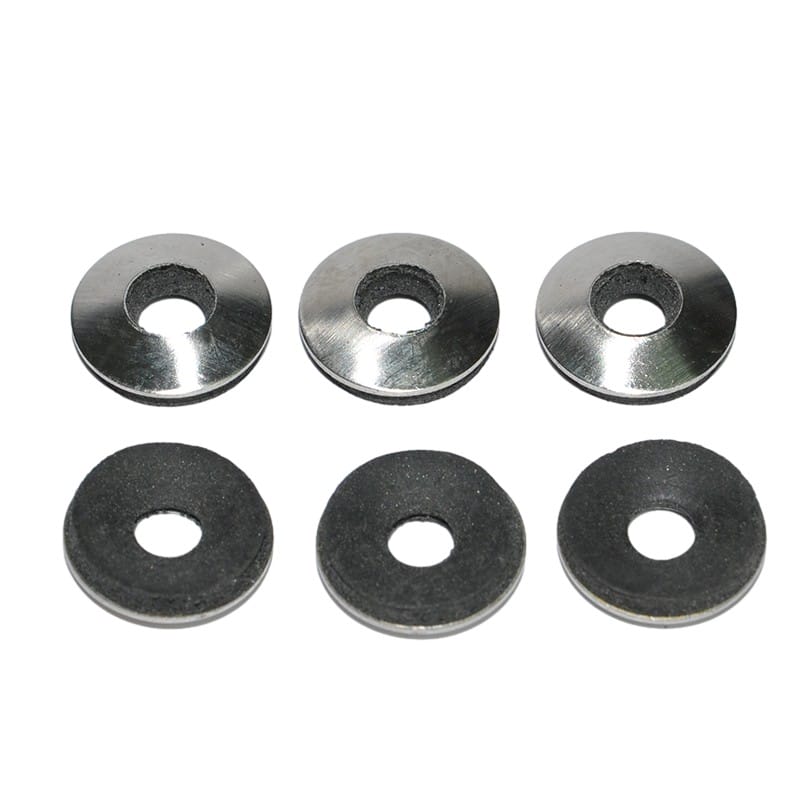 Jiaxing Aoke – Reliable Supplier of High-Performance EPDM Bonded Washers2026/07/10
Featuring prominent advantages such as aging resistance, high and low temperature resistance, water and vapor resistance, high resilience and ultra-long service life, EPDM bonded washers have become the most widely used and cost-effective sealing consumables for engineering supporting applications. ......