


Call Us
+86-573-83601567
Email Us
info@aoketrade.com

What are the respective functions of spring washers and flat washers?
Spring washers, also known as spring washers, are characterized by their elasticity. The most common type is circular, with an offset opening in the center that forms a structure resembling a single coil of a spring. This design allows the spring washer to generate elastic force when pressure is applied. This force increases the friction between the fastener and the connected component, thereby preventing loosening. Especially in environments with significant vibration, the elastic force of the spring washer can compensate for gaps caused by vibration, preventing loosening. Therefore, when installing, a higher preload is not necessarily better; if the preload is too high, it actually hinders the spring washer from effectively utilizing its elastic force.
Flat washers, on the other hand, are a simpler type of washer. They are commonly circular as well, but they are flat, unbroken circles with a large effective contact area. Their primary function is to increase the contact area between the fastener and the connected component, thereby distributing pressure per unit area and preventing the fastener from damaging the connected component. In fact, just like spring washers, flat washers require careful consideration regarding factors such as the appropriate coefficient of friction on the contact surface and the optimal material hardness, in addition to their role in distributing pressure.
APPLICATION:
Spring washers are primarily used in applications involving vibration, such as power equipment and non-stationary machinery. Additionally, they are suitable for scenarios involving frequent disassembly and reassembly, as they maintain a certain level of clamping performance even after multiple cycles.
Flat washers are commonly used in various connection points where it is necessary to increase the contact area and evenly distribute pressure, thereby protecting the surfaces of the connected parts from damage. Additionally, in situations where high surface flatness is required, flat washers can be used to compensate for surface irregularities, ensuring a tighter connection.
Send Inquiry



X
We use cookies to offer you a better browsing experience, analyze site traffic and personalize content. By using this site, you agree to our use of cookies.
Privacy Policy
News
 Guide to Selecting Fastener Materials: Material Determines Performance, Heat Treatment Determines Strength, and Surface Treatment Determines Service Life!2026/07/13
A single sentence that captures the essence of the fastener industry: Choose the wrong material, and even the strongest fastener will break; Choose the wrong heat treatment, and even the highest-rated fastener is merely a false claim; Choose the wrong surface treatment, and even the best screw wi......
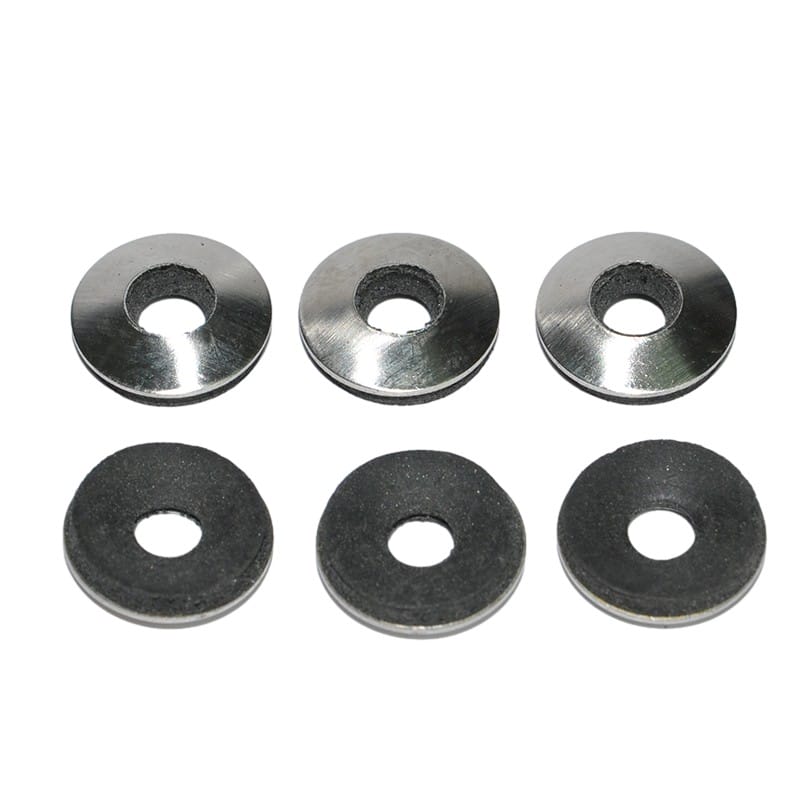 Jiaxing Aoke – Reliable Supplier of High-Performance EPDM Bonded Washers2026/07/10
Featuring prominent advantages such as aging resistance, high and low temperature resistance, water and vapor resistance, high resilience and ultra-long service life, EPDM bonded washers have become the most widely used and cost-effective sealing consumables for engineering supporting applications. ......